· ReadyStack
Worked example
Real numbers from this tool, line by line.
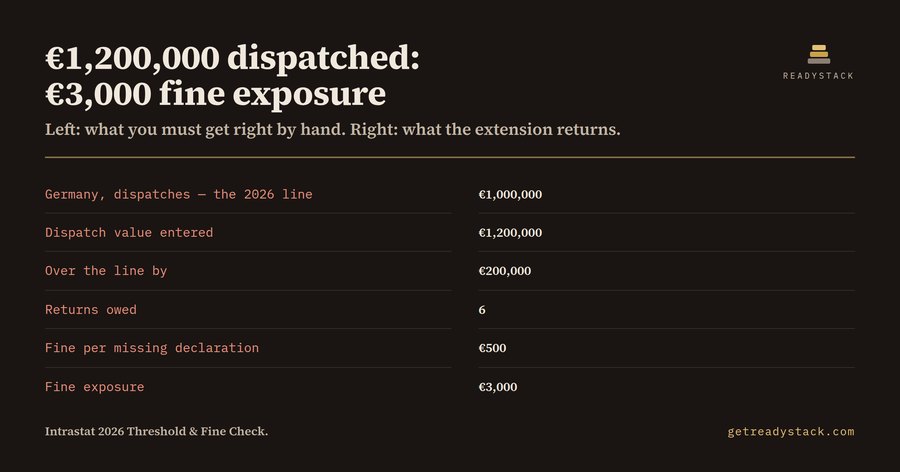
A finance manager in Germany sitting on €1,200,000 of intra-EU dispatches and six unfiled Intrastat returns is €3,000 exposed, against a German statutory ceiling of up to €50,000 for a missing declaration. That whole sentence is arithmetic, and every figure in it moves depending on which country you are filing in and which year's table you happened to read.
Intrastat is the monthly statistical declaration on goods moving between EU member states. You owe it once your value crosses a nationally set threshold. Germany's 2026 line is €3,000,000 for arrivals and €1,000,000 for dispatches. Spain sets €400,000 in both directions. Belgium takes €1,500,000 and €1,000,000. Ireland is €750,000 and €755,000 — not a typo, the two directions genuinely differ by €5,000. Portugal is €650,000 and €600,000. None of these are memorable or stable.
The failure that costs money is not the arithmetic. It is a stale number. Italy raised its monthly threshold for intra-EU acquisitions of goods from €350,000 to €2,000,000 for 2026. If you check against a table built on the old figure, or ask a chatbot whose training predates the change, you will be told a return is due on €1,500,000 of arrivals when in fact you are €500,000 below the line. That error costs you work you never owed, filed monthly, forever.
The reverse error is worse. Germany treats a missing Intrastat return as an offence carrying up to €50,000. Six months of silence at a €500 fine per declaration is €3,000 — and that is the modest reading, not the ceiling.
Then there is Austria, which is where the free tables stop being useful. One published 2026 table gives Austria €1,100,000 for both flows. Another gives €5,000,000 for arrivals and €1,200,000 for dispatches. They cannot both be right, and no free table tells you they disagree — each prints its own number with total confidence. France and the Netherlands publish no threshold at all: they select the companies that must file and send them a letter.
That is the gap this browser extension is built into. It carries the 2026 thresholds for nine euro-area member states in both directions, applies the one that matches your country and flow, and tells you whether a return is due, by how much you are over or under, and what your unfiled returns expose you to. It prints that country's deadline rule alongside the answer — the 10th working day in Germany, the 12th in Spain, the 25th in Italy, the 20th in Belgium, the 23rd working day in Ireland, the 15th in Portugal — and names the calendar month the next return actually covers.
Where the sources disagree, it refuses to pick: Austria returns both figures and asks you for yours. France and the Netherlands return the plain statement that you file only on an authority letter. Every threshold in the tool can be overridden, because the person doing the filing often has a letter in hand that beats any published table.
All of that is free, with no key, no watermark and no cap on how many times you check. The paid layer sits on a different axis — keeping the answer and repeating it: a .csv export of the checked figures for the audit file, and reminders 30, 14 and 1 days before the due date you entered. For comparison, outsourcing the paperwork starts at €299 per country for registration alone, before a single monthly filing fee.
Your trade values never leave the tab. The only outbound request the extension makes is licence-key validation, and only when you type a key.
Figures here come from the 2026 Intrastat threshold tables published by Eurofiscalis and Marosa VAT, cross-checked against each other on 19 September 2026.
Questions people ask
What does this extension actually do?
You pick an EU member state and a flow - goods arriving from the EU or dispatched to it - and enter your value for the period. It applies that country's 2026 Intrastat threshold, tells you whether a monthly return is due, how far over or under the line you sit, and what the returns you have not filed expose you to.
Who is it for?
Finance, VAT and logistics staff at companies that ship goods between EU member states, and the bookkeepers who file for them. It is built for the person who has to answer whether a return is due this month in Germany, Italy, Spain, Belgium, Ireland or Portugal, and cannot risk an out-of-date figure.
Why not just use a free threshold table or a chatbot?
Because the free tables disagree and go stale. Italy moved its monthly arrivals threshold from 350,000 to 2,000,000 for 2026; Austria is published as 1,100,000 by one provider and 5,000,000 by another; France and the Netherlands publish nothing and notify by letter. A number with no year attached is a liability.
What is free and what needs the key?
Every check is free and unlimited - all nine countries, both flows, the threshold applied, the overshoot, the returns owed, the fine exposure and the deadline rule. The 60 dollar key adds two things on a different axis: a .csv export you keep for the audit file, and reminders 30, 14 and 1 days before your due date.
What would this cost otherwise?
Outsourcing the paperwork starts higher than the tool: DutyPay lists country-specific Intrastat registration from 299 euro per country, before monthly filing fees. Germany treats a missing Intrastat return as an offence carrying up to 50,000 euro. Figures checked against the 2026 Eurofiscalis and Marosa VAT threshold tables on 19 September 2026.
Ask about this tool
One question, answered by the person who built it. Your email only if you want the answer sent.